
Pointless gardening stories
On the tribulations of a gardener

Return in style? I don't think so.
The May article was supposed to be a mini-monograph on useful insects in the garden (something very practical) but it didn’t happen. Then I considered writing an existentialist piece on the clash between mechanicism and spiritualism in the perception of the garden, but that also fell through. An article on nutrient depletion in vegetables? Not really my field.
In the end, since I still don’t have the time to seriously tackle any topic (the last few months have been hellishly busy), I thought, for once, I’d write about my own business... Something that seems all the rage here on Substack, a platform for self-referential narcissists (Someone even suggested I write a book about a gardener's musings!).
So there you have it.
I have often described my work as solitary, a kind of hermitage between the physical and ideal boundaries of the space that constitutes the garden. Yet, public relations are central to my craft. I’m not referring solely to the need to find new clients, retain old ones, dabble in explanations of elementary plant physiology or explain the design of a new garden: the gardener often serves as a mediator of disputes or, more simply, as an expendable sacrificial victim in the conflicts of others. I have identified at least three such scenarios:
Infighting
These are perhaps the worst cases. Arrangements are made with a client to define the work and operations to be carried out in the garden. The client, finally satisfied that everything has been clarified, says goodbye and heads to work. Half an hour later, from one of the glass doors leading to the patio, his wife appears:
“Please cut that hedge lower, and forget about trimming that bush so much, thank you.”
“Actually, Madam, those were not the arrangements made with your husband..”
“Oh, just leave it alone and do as I say.”
I proceed. What else could I do? Regularly, the husband returns from his business and becomes enraged upon noticing how the state of the garden differs from his original wishes. An argument ensues between the husband and wife, often in rather heated tones, which I must witness with some embarrassment (this phenomenon repeats sometimes itself several times throughout the day, as if in a farcical play: one character exits the scene, and the other takes over).
At the start of my career, I dreaded these episodes and feared these marital disputes. How was I supposed to handle it? Should I recognise a greater authority among those who in my eyes were equal principals? Should I assume responsibilities I wasn't entitled to? Now, with a bit more relational experience, I take it all in stride and use a standardised formula that usually goes something like this:
“Madam, I cannot take responsibility for these changes in front of your husband.”
The classic response?
“Don't worry, dear, I'll argue with him.”
Disputes between third parties
These types of disputes are the most insidious for the poor gardener, left at the mercy of conflicting parties. The most dangerous cases typically involve maintaining gardens along property boundaries. The plot is always the same: arrangements are made with the client to cut the border hedge or prune the tree dangerously close to the neighbour's estate. As soon as the client departs, and I am about to work independently, the neighbour, usually a pensioner or elderly lady, appears out of nowhere. Without so much as a greeting, they command, “You're going to cut that branch too, aren't you?” or “You’ll have to lower the hedge much more.” Imperatives, with no apparent room for negotiation.
Since these individuals are already on the offensive, any attempt to oppose their demands only intensifies their aggression. For them, it’s a matter of life and death. They’ve been insisting on these changes for centuries, because when the previous owner was around, or when their father was still alive, or when the boundaries were originally demarcated by ancient Celtic menhirs, things were done differently. They’ll mention that even the surveyor certified it, the lawyer approved it, and the magistrate supported it! It’s an intergenerational feud.
In such cases, resistance is futile. It’s better to glide away, like water slipping between the stones of a stream. Dissemble, nod, be patient, sometimes even conceal oneself. In the most desperate cases, offer some token gesture that won’t impact the final outcome of the work. Another reasonable approach is to reply, “I’ve already made specific arrangements with my client. If you're unhappy, I suggest speaking directly to them.” In the end, you get by, even if it means spending the entire day under watchful eyes.
Insidious displays of ignorance
I have encountered this third phenomenology several times. Unfortunately, when faced with a stolid obtuseness, a blindness to beauty (however subjective), and a complete lack of garden culture, where the garden is seen purely as a place for the indiscriminate mutilation of plants, I can't help but be (intimately) furious. Let me share a recent example.
One day, I had the misfortune of being outside the protective tree canopy while working in a wooded garden in a residential area. I was intercepted by a distinguished lady peering from the large window of a stately mansion on the adjacent property. Her approach was very polite and courteous: compliments on my work, general remarks on the possibility and good fortune of enjoying the gardens, wishes for finding good gardeners to dutifully take care of the plants... But soon, her real agenda became clear.
“But in that garden... I guess you'll have to do a lot of cutting, won't you?” she asked.
“What?” I was genuinely puzzled.
“Yes, all those trees – there are so many, and they’re so tall! It looks like a forest!”
By now, I understood where this was going. The lady was looking in me for a chainsaw accomplice and expected me to confess to her my irrepressible eagerness for felling. Very wrong! At that point, I’d have done anything but give her the satisfaction.
“Indeed, Madam, it does look like a forest and it’s beautiful.” I replied.
“But woods should be in the countryside, don’t you think? Here we are in the city!”
“And how lucky, Madam, to have so much greenery right in front of your house!”
“It looks like an overgrown thicket, and the view! I can hardly see the sea anymore.”
“Well, Madam, as I understand it, the view isn’t a legal justification for cutting down trees.”
“But at least that huge tree in the middle of the garden will need to be lowered nicely.”
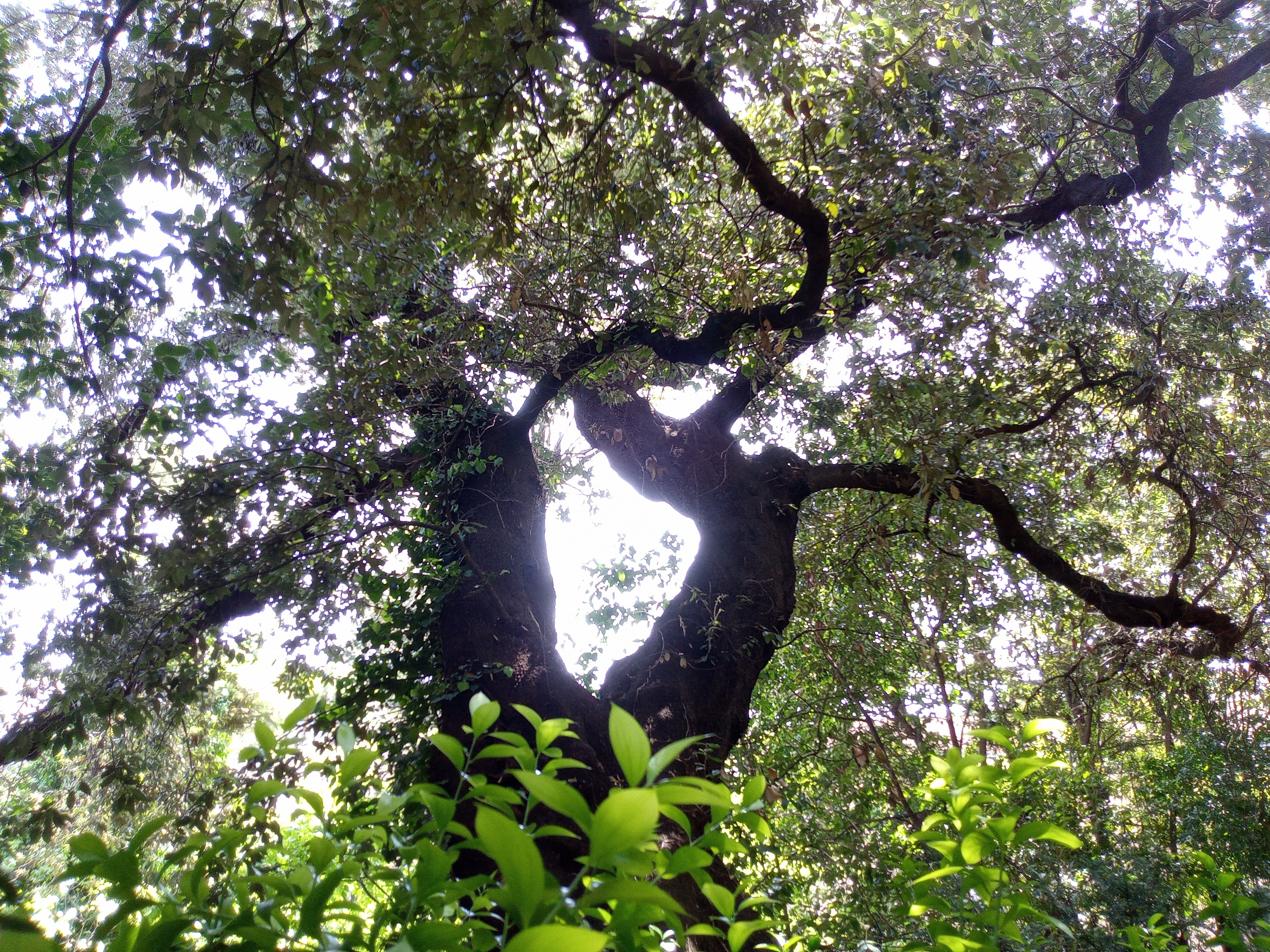
“The beautiful holm oak, Madam? That tree is over three hundred years old, it won’t be touched.”
The conversation, which had by now become a polite squabble, continued in this vein for a while. When the lady, prostrate and annoyed, finally realised she wasn’t going to get her way, tried one last desperate tactic: “What about the fire risk?!”
After this last observation, I could not help but cast my gaze towards the wooded area of the Botanical Garden, with the large redwood towering over the institute, a short distance away as the crow flies. “OK,” I said to myself, “Climax reached, time to end the conversation.”
“Alright, Madam, I will make sure to pass your concerns to the estate.”
Some people, it seems, would be happiest living in a boundless expanse of asphalt. Like those who complain that plants “litter”.
That’s all. Continuing to write on Substack, however, feels completely meaningless. I’ll keep doing it, but sporadically and at random, I think.
You have to put in the effort to be noticed, and frankly, I don’t have the slightest “social attitude” for promoting myself. Who cares.
Ah, since one of the main targets of this publication is to give gardening tips, here’s one:
if hydrangeas do not flower, it is often because they do not receive enough direct sunlight.
At least now I don’t feel guilty for just telling my business. Goodbye.
Now i will start going back and reading your gardening columns. My mind is turning to porridge with too much politics/covid.
Well, i for one, found that article very interesting and informative. Like you, i tend to slide around like water, unlike my now-deceased partner of many years who liked nothing better than a multi-generational feud over not much. It should come as no surprise to learn that i was born and raised in Canada. He on the other hand, was a Belfast man. An asphalt fan.